
What Will WhatsApp Charge for Service Replies Starting October 2026?
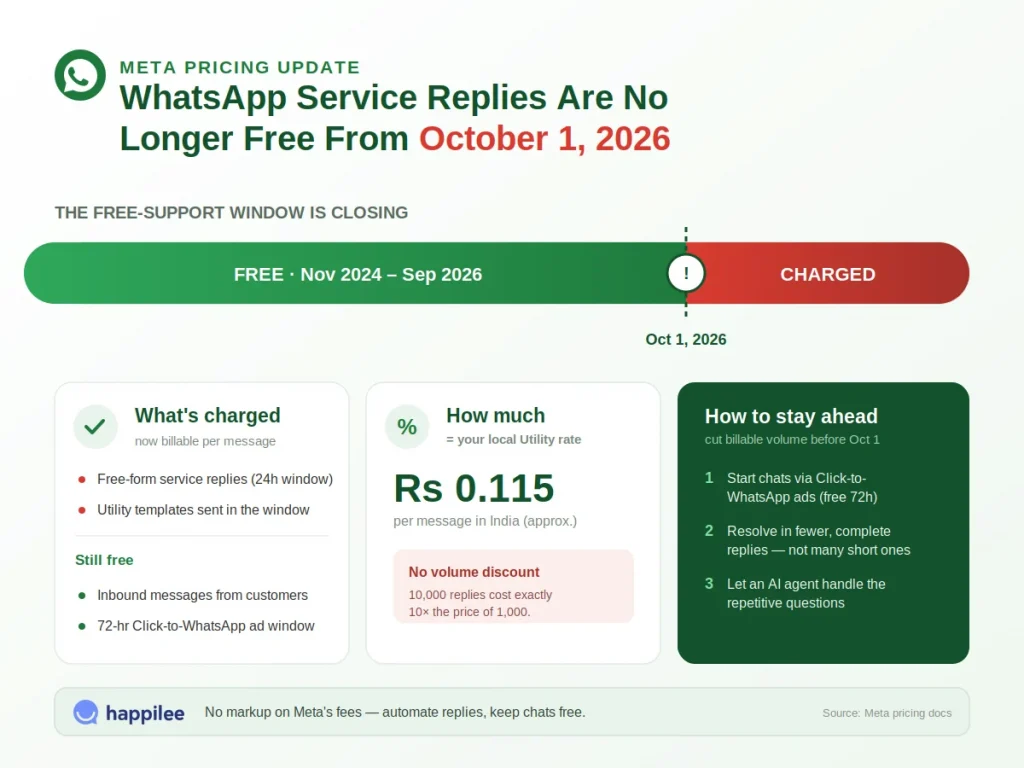
From October 1, 2026, WhatsApp service messages are billable. A service message is any free-form reply your team or a third-party chatbot sends inside the 24-hour customer service window. It had been free since November 2024. From October it costs the same per-message rate as a utility or authentication template in that country — about ₹0.115 in India — with no volume discount. Utility templates sent inside the window also lose their free status the same day. Conversations opened from a Click-to-WhatsApp ad keep their free 72-hour window, now your best tool for keeping replies free.
The free support window is closing
A customer messages, “Is this back in stock?” Your agent replies, a short back-and-forth follows, and the whole exchange sits inside a free 24-hour window. For nearly two years, that conversation cost your business nothing. From October 1, 2026, it does.
This is the biggest shift in WhatsApp service message pricing since Meta moved from conversation-based to per-message billing in July 2025. It doesn’t touch marketing budgets, which were always metered. It lands on customer support — the part of most businesses that ran on free messaging and never had a real cost model. If support has been a ₹0 line in your WhatsApp budget, that line is about to have a number. The teams that understand the details now will pay far less than the ones that find out from their October invoice.
What is a WhatsApp service message?
This is the part most teams get wrong, so it’s worth nailing down. A service message is a reply that is all three of these at once: it’s free-form (not an approved template), sent inside the open 24-hour customer service window, and not generated by Meta’s own AI (the Meta Business Agent). If a human agent or a non-Meta chatbot sends it as plain text, it’s a service message — and from October, each one is a line item. Everyday examples:
- “Your order has shipped and should arrive Thursday.”
- “Can you share a screenshot of the error you’re seeing?”
- “An agent will join this chat in about two minutes.”
- “Happy to help — which size were you after?”
These operational, human replies make up the bulk of real support conversations. Until September 30, 2026, they’re free. After that, they’re billed — unless they fall inside a free window (more on that below).
What changed, and when: the full history
Here’s how the free-and-charged status of each message type breaks down over time, so you can see exactly what October changes:
| Message type (inside 24h window) | Status timeline | From Oct 1, 2026 |
| Service messages | Free Nov 2024 → Sep 2026 | Billed |
| Utility templates | Charged pre-Jul 2025 · free Jul 2025–Sep 2026 | Billed again |
| Authentication templates | Always charged in-window | Billed (no change) |
| Meta Business Agent (Meta’s AI) | Token billing from Aug 1, 2026 | Per token |
| Customer-initiated messages | Always free | Free (no change) |
| Replies in 72h entry-point window | Always free | Free (no change) |
The utility-template row is the one most teams miss. If Meta charged only for service messages, businesses could shift in-window replies into utility templates to stay free. Meta closed that door on the same day. The practical result: almost any response you send a customer inside the window is now metered, whatever form it takes.
Two meters: service messages vs. Meta Business Agent
The subtlety that trips people up is that Meta now meters AI and humans differently. Who — or what — sends the reply decides how you’re billed:
| Service message | Meta Business Agent | |
| Who sends it | Human agent or third-party AI | Meta’s built-in AI agent |
| Billing meter | Per message | Per token |
| Rate | Local utility/auth rate | $2.00 / 1M tokens (~4–5¢/msg) |
| Volume discount | None | N/A (token-based) |
| Starts | October 1, 2026 | August 1, 2026 |
One nuance worth knowing: a third-party AI bot is treated as a service message, so it pays its own AI cost plus Meta’s per-message delivery charge. Meta’s native agent bundles compute and delivery into one token price. Neither is universally cheaper — it depends on your conversation length and complexity — but it’s a real decision to model rather than assume.
How much will service messages actually cost?
The rule to remember: a service message costs the same per-message rate Meta already charges for utility and authentication templates in that country. So your cost depends on where your customers are. Meta publishes exact October rates by September 1, 2026, but today’s template rates give a reliable ballpark. Confirm live figures on Meta’s official WhatsApp pricing page before budgeting.
| Market | Approx. service-message rate | Notes |
| India | ≈ ₹0.115 / msg | Matches utility/auth; add 18% GST |
| Brazil | ≈ $0.0068 / msg | Meta’s own illustrative example |
| United Kingdom | Higher (GBP utility rate) | Multiples of the India rate |
| UAE / Saudi Arabia | Higher (AED / SAR utility rate) | Confirm post-2026 rate card |
| United States | US utility/auth rate | No volume discount applies |
Rates are Meta’s charges only, before tax and before any provider platform fee. They are illustrative and change quarterly.
The math is where it bites
The headline rate looks tiny. Because you’re now charged per reply, a chatty conversation gets expensive fast. A worked example for an India-based team:
| One delivery query, resolved in 6 free-text replies.
Today: ₹0. From October: 6 × ₹0.115 ≈ ₹0.69 for that one chat. Now scale it: 5,000 support chats/month × ~6 replies = 30,000 service messages ≈ ₹3,450/month (≈ ₹4,071 with 18% GST) — a line item that used to read ₹0. |
Small per message, but it scales linearly and never discounts. The higher your inbound support volume, the more it matters — and in higher-rate markets like the UK, UAE or Germany, the same volume costs many times more. This is why how a conversation starts and how replies are structured now matter as much as the rate itself.
Who this hits hardest
The impact depends almost entirely on your inbound-to-outbound ratio. Broadly:
| Business type | Exposure | Why |
| Clinics, delivery, property, travel | High | Volume is mostly inbound questions — nearly every reply was free |
| D2C / e-commerce support | Medium–High | Heavy post-purchase and query traffic inside the window |
| Marketing-led brands | Low–Medium | Spend was already dominated by outbound templates |
| Sales teams (ad-driven) | Low | Click-to-WhatsApp ads keep the 72h window free |
Why is Meta doing this?
Three reasons, and none is hard to read. First, the 24-hour window has been free for almost two years — an enormous volume of business traffic Meta wasn’t charging for; reintroducing the fee monetizes it directly. Second, the token model lets Meta price its own AI by the compute a conversation actually consumes rather than a flat fee. Third, per-message pricing nudges businesses toward fewer, better messages — the same anti-spam logic behind Meta’s earlier rate restructuring. Fewer, higher-quality messages protect the experience that keeps people on WhatsApp in the first place.
What is NOT changing
- Customer-initiated messages stay free.Inbound messages from users cost nothing.
- The 24-hour window still works the same way.It opens and resets on each customer message and still governs free-form vs. template — only the price of sending inside it changed.
- The 72-hour free entry-point window is untouched.Ad- and CTA-started chats keep free delivery.
- Marketing, utility and authentication template structures are unchanged.Volume tiers on utility/auth still apply.
- The regular WhatsApp Business app is unaffected.This is a WhatsApp Business Platform (API) change only.
How to keep your WhatsApp costs under control
You don’t have to absorb this blindly. The businesses that come out ahead will make a handful of practical changes before October 1:
1. Protect your free windows
The single biggest lever. Route more first-touch demand through Click-to-WhatsApp ads and Facebook/Instagram CTAs, which open a 72-hour window where message delivery is free. Ad-started conversations keep a large share of your replies free even after October.
2. Resolve in fewer turns
A single, well-structured reply beats five fragmented ones. Because service messages are billed per message with no discount, consolidating your responses directly reduces what you pay. Train agents and design flows to answer completely in one message.
3. Move data collection into WhatsApp Flows
Capturing a name, address or preference in one interactive WhatsApp Flow replaces a chain of charged back-and-forth replies — fewer billable messages for the same outcome.
4. Use templates where they fit
Order updates, OTPs and status alerts belong in utility or authentication templates — predictable, compliant, and often the smarter unit cost because they still carry volume discounts that service messages don’t.
5. Let AI handle the repetitive 80%
An AI agent or no-code chatbot that resolves common questions end-to-end — ideally inside a free window — keeps humans (and their per-message replies) focused on the conversations that truly need them. This is exactly the behaviour the new pricing rewards.
6. Audit your service-message volume now
Pull last month’s numbers: how many replies did each business number send inside the 24-hour window, broken down by recipient market? That baseline is the only way to estimate your October exposure. Your provider’s analytics should show it.
7. Confirm billing before September 30
With a new billable category switching on, make sure your payment method in Meta Business Suite is valid well ahead of the change, so a declined charge never interrupts delivery.
| Your pre-October checklist
✓ Pull your last 30 days of in-window service-reply volume, by market ✓ Confirm your market’s service rate once Meta publishes it (by Sep 1) ✓ Shift first-touch demand toward Click-to-WhatsApp ads ✓ Convert multi-step data collection into WhatsApp Flows ✓ Route repetitive queries to an AI agent / chatbot ✓ Verify billing details in Meta Business Suite before Sep 30 |
How Happilee helps you get ahead of the change
This is the moment a WhatsApp platform stops being a nice-to-have and starts paying for itself. Happilee is an official Meta Business Solution Provider built to help marketing, sales and support teams do more with fewer, smarter messages — exactly what the new pricing rewards — and it charges no markup on Meta’s per-message fees, so you pay Meta’s rate, not a padded one.
- AI agents that resolve in a turn or two— qualify leads, answer FAQs and close routine tickets end-to-end instead of a long human thread.
- No-code chatbots and WhatsApp Flowscollect information in one interactive step, so you’re not paying for a chain of follow-ups.
- Click-to-WhatsApp ad journeysthat open the free 72-hour entry-point window by design.
- Broadcasts, templates and analytics in one placeto shift structured updates into templates and see where your spend goes by category.
- Cost visibilityso you can model the October change and manage it before it hits your bill.
| Get ahead of October before it hits your bill. See how Happilee’s AI agents, WhatsApp Flows and unified inbox help you resolve more in fewer messages — with no markup on Meta’s fees.
Start your free trial on Happilee → · Explore the WhatsApp Business API → |
The 2026 pricing timeline at a glance
| Date | What happens | Why it matters |
| Aug 1, 2026 | Meta Business Agent moves to token billing | Meta’s AI replies cost ~$2/1M tokens (~4–5¢/msg) |
| By Sep 1, 2026 | Meta publishes final per-country October rates | You’ll know the exact service-message price per market |
| Oct 1, 2026 | Service messages become billable | Every non-template, non-Meta-AI reply in the 24h window is charged |
Meta updates pricing only on the first day of each quarter (Jan 1, Apr 1, Jul 1, Oct 1). This guide reflects public information as of September 2026; always confirm current rates in Meta’s documentation and with your provider before budgeting.
Final thoughts
The October 1 change is significant, but it isn’t a reason to retreat from WhatsApp — it’s a reason to be intentional. Route more conversations through the free 72-hour entry point, resolve queries with automation inside free windows, consolidate replies, and use utility templates where their volume discounts help. Do that, and WhatsApp stays what it has always been: the highest-engagement channel you have. With a transparent, no-markup provider like Happilee, the economics keep working in your favour.
Frequently asked questions
What is changing in WhatsApp service message pricing in October 2026?
From October 1, 2026, service messages — free-form replies a business sends inside the 24-hour customer service window — become billable per message. Utility templates sent inside that window also lose the free status they’d held since July 2025. Both are charged at the local utility/authentication rate. The change applies only to the WhatsApp Business Platform (API).
What exactly is a service message?
A reply that is free-form (not an approved template), sent inside the open 24-hour window, and not generated by Meta’s own AI. The everyday “sure, let me check that” or “your order shipped” messages your team or a third-party chatbot sends. Free until September 30, 2026; billable from October 1, 2026.
How much does a WhatsApp service message cost?
The same per-message rate as a utility or authentication template to that country, with no volume discount. In India that’s roughly ₹0.115 per message (before 18% GST); in Brazil, about $0.0068 per Meta’s own example. Meta publishes exact per-country rates by September 1, 2026.
Will every reply I send now cost money?
Every free-text reply inside the 24-hour window is billable as a service message from October 1, 2026 — unless it’s generated by Meta’s own Business Agent (billed by token) or sent inside the free 72-hour entry-point window opened by a Click-to-WhatsApp ad or Facebook/Instagram CTA.
Is the 24-hour customer service window going away?
No. It still opens each time a customer messages you and still determines whether you can send free-form messages or must use a template. Only the price changed — sending inside it is no longer free.
Does this affect regular WhatsApp users or the WhatsApp Business app?
No. The free WhatsApp app and the WhatsApp Business app (used without the API) are unaffected. This change applies only to businesses on the WhatsApp Business Platform — typically those using automation, shared inboxes and CRM integrations.
Is Meta’s AI cheaper than a third-party AI bot on WhatsApp?
It depends. Meta Business Agent is billed per token (~4–5¢ a message). A third-party AI bot is treated as a service message, so it pays its own AI cost plus Meta’s per-message delivery charge, which can make it more expensive overall for long conversations. Model both against your typical chat length.
How can I reduce my WhatsApp service message costs?
Resolve issues in fewer replies, move data collection into WhatsApp Flows, use utility/authentication templates for structured updates, route first-touch demand through Click-to-WhatsApp ads to keep the free 72-hour window, and let an AI agent handle repetitive questions so humans send fewer billable replies. A no-markup provider like Happilee helps on both the rate and the automation side.