
Short answer: For promotions, RCS is now cheaper per message; for transactional updates, WhatsApp is. A WhatsApp marketing message to an Indian number costs ₹0.8631 at Meta’s list rate, against roughly ₹0.25–₹0.30 for a promotional RCS message after the 1 September 2026 revision. But a WhatsApp utility or authentication message costs ₹0.115, while Jio’s transactional RCS rate is ₹0.25. All rates exclude 18% GST.
WhatsApp vs RCS rate card for India (October 2026)
WhatsApp and RCS now price messages the same way: per delivered message, by category. That makes a like-for-like comparison possible for the first time. The table below lines up the categories that map onto each other.
| Message type | WhatsApp (Meta list rate) | RCS (from 1 Sep 2026) | Cheaper per send |
|---|---|---|---|
| Promotional / marketing | ₹0.8631 | ₹0.25–₹0.30 (Jio: ₹0.27–₹0.30) | RCS, by about 2.9–3.5× |
| Transactional / utility (order, booking, payment updates) | ₹0.115 | ₹0.11–₹0.25 (Jio: ₹0.25; providers: ₹0.11–₹0.15) | WhatsApp or level, depending on operator |
| OTP / authentication | ₹0.115 | ₹0.11–₹0.16 (Jio) | Roughly level |
| Replies inside a customer-started chat | First 1,000 per number per month free, then ₹0.115 | About ₹0.13 (provider-quoted conversational rate) | WhatsApp up to 1,000; level after |
| Free windows | Click-to-WhatsApp ad chats: up to 7 days free | None in the operator or provider rate cards we reviewed |
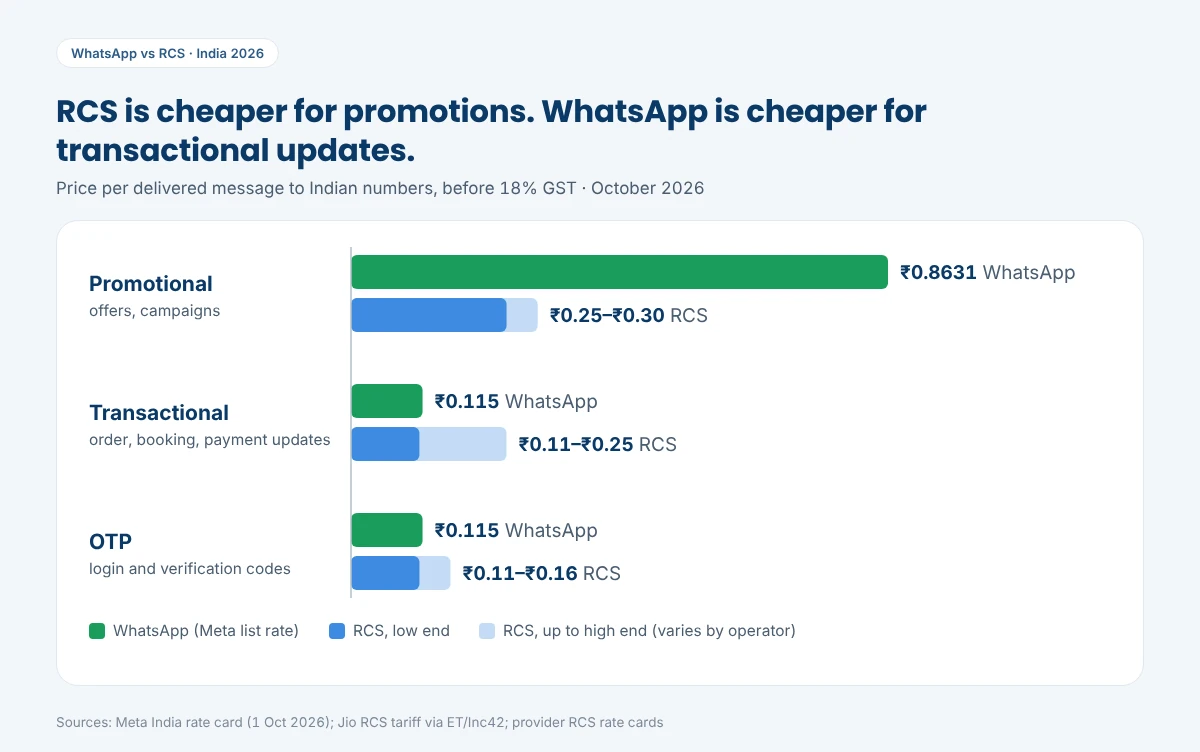
Per delivered message to Indian numbers, before 18% GST. WhatsApp: Meta’s India rate card effective 1 October 2026. RCS: Jio’s tariff as reported by ET via Inc42 and TelecomTalk, plus published provider rate cards. RCS prices vary by operator, format and volume; ask your provider for a quote.
Two things stand out. First, the old shortcut “RCS is the cheap channel” now only holds for promotions. For an order update, Meta’s ₹0.115 utility rate undercuts Jio’s ₹0.25 transactional RCS rate by more than half.
Second, the gap that matters most on WhatsApp is the one between its own categories: a marketing message costs 7.5× a utility message. Getting a template categorised as utility instead of marketing saves more per message than any channel switch.
What changed between September and October 2026
Two channels re-priced inside one quarter, and Meta has more changes queued for 2027. Here is every date that affects an Indian business’s messaging bill, including two that most coverage skips: the INR billing deadline and the max-price roadmap.
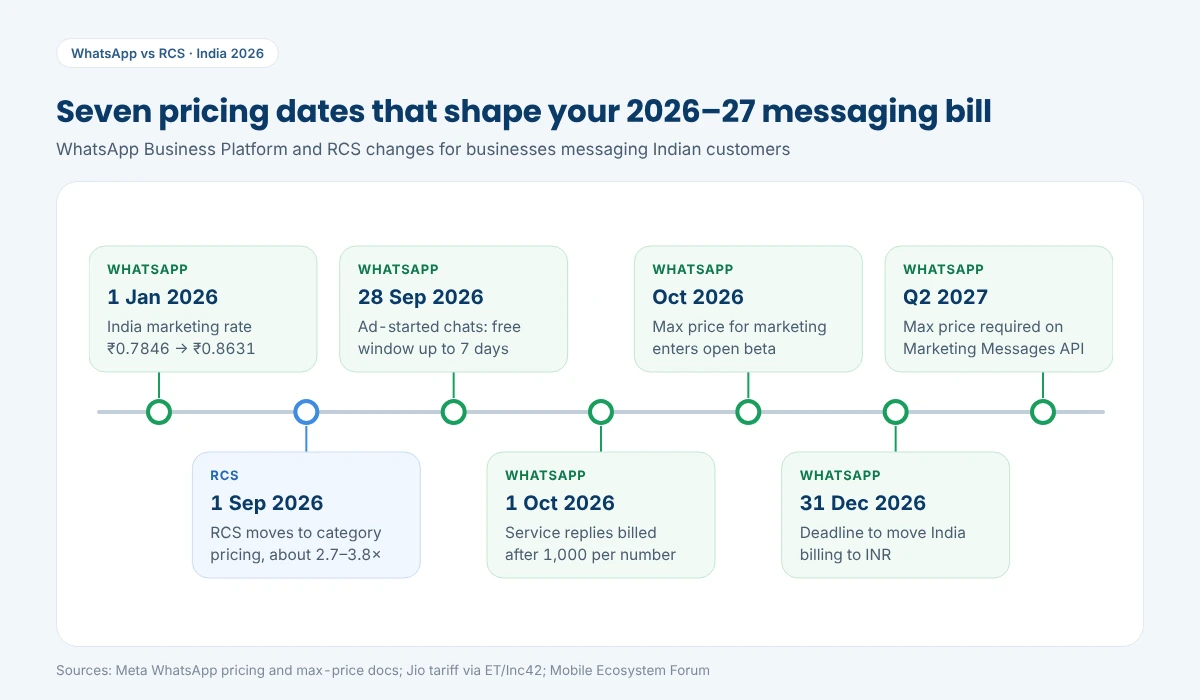
| Date | Channel | What changed | What it means for your bill |
|---|---|---|---|
| 1 Jan 2026 | India marketing rate rose about 10%, from ₹0.7846 to ₹0.8631 | Every promotional send costs more; utility unchanged | |
| 1 Sep 2026 | RCS | Category pricing replaces flat rates; Jio extends business RCS to iPhone users on its network | Promotional RCS roughly triples; iPhone reach on Jio opens up |
| 28 Sep 2026 | Free entry point window for Click-to-WhatsApp ad chats extended from 72 hours to up to 7 days | A week of free follow-up for leads from ads, if you reply within 24 hours | |
| 1 Oct 2026 | Service replies charged after 1,000 free per number per month; utility templates inside an open chat charged | Support teams get a bill for the first time since November 2024 | |
| Oct 2026 | Max price for marketing messages enters open beta on the Marketing Messages API | Optional: cap or raise what you pay per marketing delivery | |
| 1 Nov 2026 | Max-price traffic moves to its own billing line on invoices | Easier to see what bidding saved or cost | |
| 31 Dec 2026 | Deadline for India-billed accounts to move to INR billing | Non-INR accounts of eligible businesses stop delivering from 1 Jan 2027 | |
| Q2 2027 | Max price becomes required in eligible countries on the Marketing Messages API | Fixed published marketing rates remain only on the Cloud API |
Sources: Meta WhatsApp Business Platform pricing and max-price documentation; Jio tariff reporting by ET via Inc42; Mobile Ecosystem Forum analysis of the RCS increase.
Is WhatsApp marketing now an auction? Not for most senders yet. Some October coverage described it that way, but Meta’s documentation says max price is opt-in on the Marketing Messages API during the beta. Templates without a max price keep the published ₹0.8631 rate, and the Cloud API keeps fixed rates even after the Q2 2027 change. Our guide to the Marketing Messages API explains how that API differs from the Cloud API.
The October WhatsApp change is covered in depth in our WhatsApp service message pricing guide, and the wallet and UPI top-up changes that came with it are in WhatsApp Business API billing, decoded. If you are new to per-message billing, start with how Meta’s per-message pricing works.
Cost per message vs cost per result: the break-even rule
A cheaper message only saves money if it produces results at a similar rate. The number that decides your budget is cost per conversion: what you paid for the messages divided by the sales, bookings or replies they produced.
WhatsApp wins when its conversion rate divided by RCS’s conversion rate is greater than WhatsApp’s price divided by RCS’s price. Plug in October 2026 India prices for promotions and you get the break-even multiple: how many times better WhatsApp has to convert before it is the cheaper channel per sale.
| WhatsApp price you pay | vs RCS at ₹0.30 | vs RCS at ₹0.25 |
|---|---|---|
| ₹0.8631 (Meta’s rate, no markup) | 2.9× | 3.5× |
| ₹1.09 (a provider charging ~26% above Meta) | 3.6× | 4.4× |
Break-even multiple = WhatsApp price ÷ RCS price. If WhatsApp converts better than this multiple, it costs less per conversion.
Two practical reads of this table:
- For warm audiences, WhatsApp usually clears the bar. Cart reminders, appointment rebooking and offers to recent buyers tend to convert at several times the rate of a cold blast, because the customer can reply, ask a question and buy in the same thread.
- A markup quietly moves the line. At ₹1.09 per marketing message, WhatsApp needs to convert 3.6–4.4× better than RCS instead of 2.9–3.5×. Paying Meta’s rate is worth about a quarter of your break-even margin.
Example (the blog’s interactive calculator uses these defaults): 50,000 messages at ₹0.8631 on WhatsApp cost ₹43,155; at ₹0.27 on RCS they cost ₹13,500. At a 3% WhatsApp conversion rate and 1% on RCS, that is ₹28.77 vs ₹27.00 per conversion, so RCS is ₹1.77 cheaper. Raise WhatsApp to 5% and it drops to ₹17.26, ₹9.74 cheaper than RCS. The calculator lives in the HTML version of this post.
Which channel for which message
Instead of picking one channel, assign each message type to the channel that is cheapest for the job it has to do. The savings come from allocation, not from abandoning a channel.
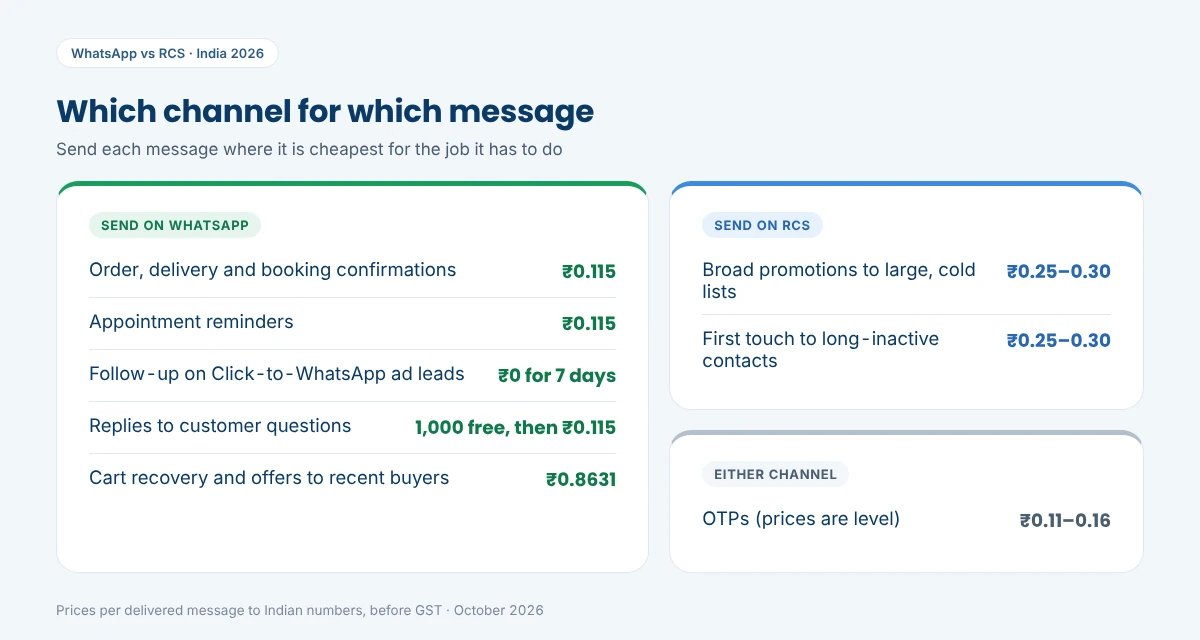
| Message | Better fit | Why |
|---|---|---|
| Order, delivery and booking confirmations | WhatsApp (utility) | ₹0.115 vs up to ₹0.25 on RCS, and customers can reply to change or cancel |
| Appointment reminders | WhatsApp (utility) | One-tap confirm or reschedule cuts no-shows; same ₹0.115 rate |
| OTPs | Either | Prices are level; pick on delivery speed and fallback |
| Follow-up on Click-to-WhatsApp ad leads | Free for up to 7 days if you reply within 24 hours | |
| Replies to customer questions | First 1,000 a month per number are free; chatbot flows keep the count low | |
| Cart recovery and offers to recent buyers | WhatsApp (marketing) | Warm audience usually clears the 2.9–3.5× conversion bar |
| Broad promotions to large, cold lists | RCS | ₹0.25–₹0.30 per send; conversion gap is often smaller than the price gap |
| Win-back of long-inactive contacts | RCS first, WhatsApp for responders | Pay the lower price to find who is still interested, then continue the conversation on WhatsApp |
A worked monthly bill: September vs October
Here is a typical mid-sized Indian business on one WhatsApp number, with Meta’s India rates and no provider markup. Each month it sends 20,000 marketing messages, 12,000 utility updates (4,000 of them while a chat is open), 3,000 OTPs and 9,000 service replies.
| Line item | September 2026 | October 2026 | October, optimised | October, 26% markup |
|---|---|---|---|---|
| Marketing | ₹17,262 | ₹17,262 | ₹12,083 | ₹21,800 |
| Utility | ₹920 | ₹1,380 | ₹1,380 | ₹1,740 |
| Authentication | ₹345 | ₹345 | ₹345 | ₹435 |
| Service replies | ₹0 | ₹920 | ₹345 | ₹1,160 |
| Total (before GST) | ₹18,527 | ₹19,907 | ₹14,153 | ₹25,135 |
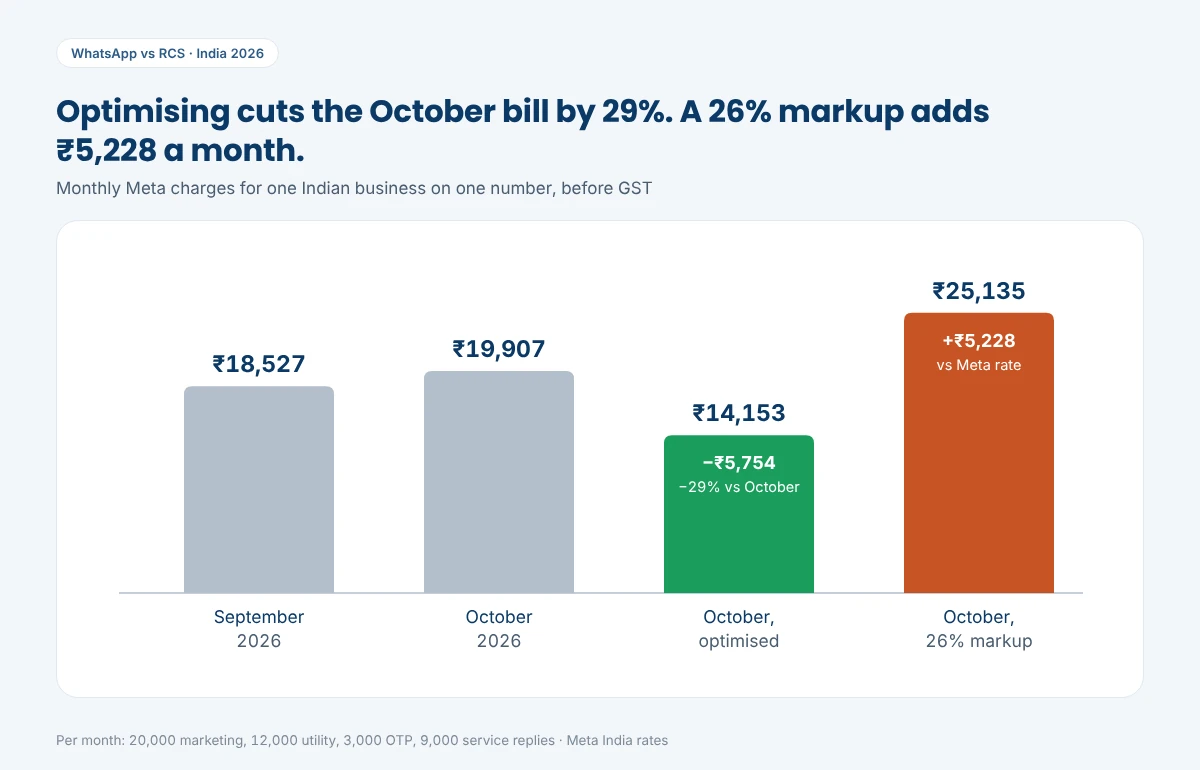
Marketing ₹0.8631; utility, authentication and service ₹0.115; markup column uses ₹1.09 and ₹0.145. September: the 4,000 in-window utility messages and all service replies were free. October: 8,000 billable service replies after the 1,000 free.
What the columns show:
- October alone adds ₹1,380 a month (+7.4%) for this business, from in-window utility messages and service replies over the free 1,000. Annoying, but small.
- The optimised column is ₹5,754 a month lower (−29%) than the October baseline. It assumes three changes: marketing sends cut from 20,000 to 14,000 by dropping contacts who haven’t engaged in 90 days, service replies cut from 9,000 to 6,000 with chatbot buttons and forms, and 2,000 of those replies handled inside Click-to-WhatsApp free windows.
- The markup column costs ₹5,228 a month more than paying Meta’s rate for the same messages, or ₹62,736 a year. That is about four times the October increase itself.
Meta’s documentation doesn’t say whether replies sent inside a free entry point window count toward the 1,000 free service messages. If they do, add ₹115 to the optimised column.
9 ways to cut WhatsApp messaging costs after October 2026
Ordered by how much they typically save, largest first.
1. Check what your provider charges per message
Open last month’s invoice and divide the marketing charge by the number of marketing messages delivered. If the result is above ₹0.8631 before GST, the difference is a markup, and since October it applies to support replies as well as campaigns. In the worked example above, a 26% markup costs ₹5,228 a month, nearly four times what the October change added.
2. Get transactional templates approved as utility
A utility message costs ₹0.115; a marketing message costs ₹0.8631. Order confirmations, booking updates, payment reminders and account alerts qualify as utility if they stick to the transaction. Adding a discount line or “shop the new collection” turns them into marketing, and Meta re-categorises templates that drift. Keep promotional content in separate templates.
3. Use the 7-day free window from Click-to-WhatsApp ads
When someone messages you from a Click-to-WhatsApp ad on the WhatsApp Android or iOS app and you reply within 24 hours, Meta opens a free entry point window that can stay open for up to 7 days. Marketing, utility, authentication and service messages inside it are free; replies written by Meta’s own AI agent are still charged. Reply fast (a chatbot can do it in seconds), qualify the lead and close the booking or sale inside the week.
4. Plan around the 1,000 free service messages per number
The allowance is 1,000 delivered service messages per business phone number per month. It does not roll over, and it resets at midnight in your messaging account’s time zone. A chain with a separate number per branch gets 1,000 per branch. Keep a payment method on file: once a number uses its free tier, Meta stops delivering further service messages from accounts without one.
5. Resolve each question in fewer messages
Every reply is a billable message, so a six-message back-and-forth costs six times a one-message answer. Replace “what’s your order number?” ping-pong with a single message that has buttons or a short form, and answer the top ten questions with a no-code chatbot that gives the full answer in one reply.
6. Stop paying to message people who never read
At ₹0.8631 each, 6,000 marketing messages to contacts who haven’t opened anything in three months cost ₹5,179 a month. Segment broadcasts by last engagement, suppress the long-inactive and, if you also run RCS, try the cheaper channel on them first.
7. Model Meta’s AI agent before switching to it
Meta Business Agent replies are billed at $2 per million tokens, which Meta estimates at about 4–5 US cents per message. At an indicative ₹87 to the dollar that is roughly ₹3.50–₹4.35 a reply, 30–38× the ₹0.115 service rate in India. For Indian traffic, a rule-based chatbot whose replies are billed as ordinary service messages is far cheaper on Meta’s meter. Our Meta Business Agent guide covers when the agent is worth it.
8. Test max price when it reaches your account
On the Marketing Messages API, max price lets you set the most you will pay per marketing delivery; Meta charges that amount or less. Meta suggests testing four arms: no max price, a max price at the rate card, one 0.9× the rate card, and one higher (1.2× for India). Run it on a mid-sized campaign before changing anything at scale.
9. Move your WhatsApp billing to INR before 31 December 2026
If your business is billed by Meta in India and your messaging account is still in USD, Meta requires migration to INR by 31 December 2026. From 1 January 2027 it stops delivering messages from eligible non-INR accounts. INR billing also removes currency-conversion swings from your monthly bill.
Exception for governments and non-profits: from 1 October 2026 through 31 December 2027, eligible government bodies and community non-profits keep free service messages beyond the 1,000 monthly tier.
Where RCS genuinely makes sense
A fair comparison names the other channel’s strengths. RCS is a good fit when:
- You are sending one-way promotions to a large list where few people need to reply. At ₹0.25–₹0.30 per send, the price advantage is hard to beat on reach.
- Your contacts haven’t opted in to WhatsApp messages. WhatsApp requires opt-in before a business messages someone. RCS follows operator and telecom consent rules instead, which your provider can confirm for your use case.
- You want native-inbox delivery with SMS fallback for alerts that must arrive even when data is off.
RCS is growing fast. Infobip data cited by Inc42 shows RCS interactions in India up 108% between H1 2025 and H1 2026, mostly from financial services.
Where RCS falls short is the conversation after the click: catalogues, bookings, payment links, shared team inboxes and chatbots are far more mature on WhatsApp. That is why the cheapest setup for most businesses is RCS for discovery and WhatsApp for everything that needs a reply.
How Happilee keeps your WhatsApp bill at Meta’s rate
Happilee is an official Meta Business Partner focused on WhatsApp. We don’t sell RCS, so this section is about making the WhatsApp side of your mix as cheap as it can be.
- No markup on Meta’s message charges. You pay ₹0.8631 per marketing message and ₹0.115 per utility, authentication or service message, the same rates in the tables above.
- Chatbots included in every plan. 3, 10 or 20 no-code chatbots on Basic, Growth and Advanced, so fewer replies need a human and fewer turns get billed.
- Click-to-WhatsApp and lead-form follow-up. CTWA analytics and Meta Leads CRM let a bot reply within seconds, inside the free window.
- Segmented broadcasts. Filters, scheduling and drip campaigns so marketing spend goes to people who engage.
- Support in English, Hindi, Malayalam and Tamil, with billing in INR, AED or USD.
Plans start at $34 a month for Growth (5 users, 15,000 conversations, up to 10 chatbots). See Happilee pricing or compare plans in detail. If you’re weighing providers, our Interakt alternatives guide and Happilee vs Wati comparison show per-message rates side by side.
CTA box — See your October bill at Meta’s rate. Send us last month’s message counts and we’ll show what the same volume costs on Happilee, with no markup on Meta’s charges. Buttons: Start free trial · Book a demo
Frequently asked questions
Is RCS cheaper than WhatsApp in India in 2026?
For promotions, yes: about ₹0.25–₹0.30 per RCS message against ₹0.8631 for a WhatsApp marketing message. For transactional updates, no: WhatsApp utility messages cost ₹0.115, while Jio’s transactional RCS rate is ₹0.25. OTP prices are roughly level. All rates exclude 18% GST.
How much does a WhatsApp Business API message cost in India from October 2026?
Meta’s India rates are ₹0.8631 per marketing message and ₹0.115 per utility, authentication or service message, before 18% GST. Each business number gets 1,000 free service messages a month. India’s rates did not change on 1 October 2026; what changed is that service replies and in-window utility templates became billable.
What is the new RCS price in India from September 2026?
From 1 September 2026, Jio charges ₹0.27–₹0.30 per marketing RCS message, ₹0.25 per transactional message and ₹0.11–₹0.16 per OTP, replacing a flat ₹0.08–₹0.10. Provider rate cards quote about ₹0.25–₹0.30 for promotional and ₹0.11–₹0.15 for transactional RCS. Prices vary by operator, format and volume.
Are WhatsApp service messages free after 1 October 2026?
The first 1,000 service messages per business phone number each month are free. From the 1,001st, each costs the utility rate, ₹0.115 in India. The allowance doesn’t roll over. Utility templates sent while a chat is open are charged from the first message.
How long is the WhatsApp free entry point window now?
Up to 7 days, since 28 September 2026 (previously 72 hours). It opens when a customer messages you from a Click-to-WhatsApp ad on the Android or iOS app and you reply within 24 hours. Inside it, marketing, utility, authentication and service messages are free; Meta Business Agent replies are still charged.
Should I move my WhatsApp promotions to RCS?
Only where WhatsApp doesn’t convert at least 2.9–3.5× better than RCS. Divide each channel’s price by its conversion rate and compare. Warm audiences such as cart abandoners and recent buyers usually convert well enough on WhatsApp; large cold lists often don’t.
Is WhatsApp marketing pricing now an auction?
Not by default. Max price is an opt-in feature on the Marketing Messages API, in open beta from October 2026. Templates without a max price keep the published rate. Meta plans to make max price required in eligible countries on that API from Q2 2027, while the Cloud API keeps fixed rates.
Do I need to switch my WhatsApp billing to INR?
If your business is billed by Meta in India, yes. Meta requires eligible messaging accounts to move to INR by 31 December 2026 and stops delivering messages from eligible non-INR accounts from 1 January 2027.
Does Happilee add a markup on WhatsApp messages, and does it offer RCS?
Happilee charges no markup on Meta’s per-message fees, so you pay ₹0.8631 per marketing message and ₹0.115 per utility, authentication or service message in India. Happilee is WhatsApp-only and doesn’t sell RCS; businesses that use RCS run it alongside Happilee.